

Bem-vindos ao Porto Alegre, BRASIL!

Porto Alegre Demographics:
73.6% White
13.4% Pardo (Multiracial)
12.6% Black
0.2% Amerindian (Indigenous Peoples)
0.2% Asian Heritage

GAUCHO!
If you’re from Rio Grande do Sul, you are “Gaucho.”
Historically, “Gaucho” translates to “skilled horseman,” and refers to cattle herders who once dominated this area of Brazil (and neighboring Argentina and Uruguay).
Why does this matter to us?
Today, Gaucho means that you are a SOUTHERNER! So both the accent we’re learning, and the people who speak with it, are Southern.
This is important for context, particularly because Brazil is a vast, culturally diverse country, and consequently is home to several distinctive accents. The sounds we’ll be learning below will place us in the heart of the south, enabling us to authentically represent Gauchos.

The national language of Brazil is PORTUGUESE.
This is due to the colonization of the indigenous territory by Portuguese explorers and conquistadors in 1500.
BRAZIL vs PORTUGAL?
Note that this is a different dialect of Portuguese than that spoken in Portugal, and the two are not mutually intelligible the way Scottish and Australian English are, for example. Thus, there are some similarities between Brazilians and Portuguese accents while speaking English, but overall they are very different accents.
The Girl From Ipanema! You may have some familiarity with Bossa Nova music, but most famous Bossa Nova music was created by folks from Rio and São Paulo, which are very different accents from Porto Alegre.
What does all this mean? It means: stay focused on the speakers and sounds below!

POSTURE
I call Brazilian Portuguese “the MEOW language.”
That means that there’s a bit of nasality to properly pronounce some Portuguese sounds that then often becomes a baseline of nasality when speaking English. For example, the little tilde (squiggle) over the “a” in São Paulo means you need a bit of nasality for that “a” vowel.
TRY IT!
TRY a few big meOWWs like you’re a hungry kitty who wants treats and pats, howling in the night.
Hold on to the NASALITY that creates as you go straight into saying “São Paulo.” Now MEOW again and say “São Paulo is nice!” and hold on to the nasality til the end of the sentence! If you ever feel lost in the accent, do a big MEOW!

MORE POSTURE
Lots of contact between blade of tongue and upper teeth (sometimes the tongue might even protrude from the teeth! on /n/ or /d/ especially)
bit of lip corner pinning
free jaw
PRONUNCIATION
Consonant Glory!
TH can be /d/ or /f/!
A “buzzy TH” like in FEATHER, THEM, THESE is likely to be /d/: These are feathers = Dese are feaders.
A “breathy TH” like THINK, THOUGHT, EARTH will be /f/: I think about the earth = I fink about de earf.
Not sure which is which?
Test out the words above with two fingers on your throat.
If your fingers vibrate on the TH, that’s a Buzzy TH!
If they don’t vibrate on the TH (and only vibrate on the vowel), then that’s a Breathy TH!
LISTEN below : “Here in the…North of our country…and then the yellow…Remember you went there Saturday, set everything up…’
PRACTICE: Now YOU try it!
Here in de Norf of our country. SomeTHing is better THan noTHing.
I THink it’s farTHer away. BoTH of THem are funny.
LISTEN to MAURO & RENATA! Hint: pay attention to letter R. Make note of anything else that grabs your ear!
HUG the Letter R!
What many speakers share is a bit of ‘hugging’ on the Rs.
HOW to HUG= Try saying “GRRRRR.” Can you feel the back sides of your tongue bracing your upper molars? That’s the R we want!
LISTEN: “In RestauRants, if you go in a fancy RestauRant and you ask foRdat…they have Moqueca heRe!”
Practice hugging the R!
I Realized I was deRe. They buRned the bRead.
The Reservation is on ThuRsday. I tRaveled to CalifoRnia.
Ending L can be /w/!
*ONLY when it’s at the end of a word like “bill” or when it’s before a consonant, like in “building” (=biw & biwding)
LISTEN: “to make this a cheap meal…all yellow…so simple…Falls…my wall…trying to sell for months”
Practice:
PeopLe love heavy metaL. I toLd PauL to hoLd my caLLs.
I’m not availabLe. The bottLe is stiLL fuLL.
Let’s PRACTICE the tongue on the teeth for /t, d, n/:
You can imagine you have some peanut butter on your tongue & you’re scraping it off against your top teeth!.
Hint: /t/ can be more breathy! “tomorrow”
Listen: “to the Las Vegas show…and then we needed two cars…”
I don’t know. I need two.
The time is now. Definitely not.
VOWEL GLORY!
LISTEN to how Nanda says “kids” and “missing” and how Marcio says “ninety”…and more!
“IH” like in IF, LIFT, WISH, KIT - more “EE” /i/
LISTEN: “busy…that lives here…like pink…it’s different…pretty bad.”
Practice:
I think this is interesting. We missed the intro to the film.
I wish the fish was grilled. Where’s the drinks list?
“UH" like in FOOT, GOOD, COULD, PUT - more “oo” /u/
LISTEN: “they should…and they took…”
Practice:
That’s a good look for you. Could I have the book?
The woman knocked on wood! You shouldn’t cook pudding.
“EE” like in EAT, EASY, FEET, FLEECE - shorten almost to “IH” /ɪ/
LISTEN: “at least…a deep sleep…don’t speak…Where’s the beach?!”
Practice:
We need to be seen. These are cheap seats!
The beach is in between two streets.
“I” like in I’M, AISLE, HIGH, TRY, PRICE: drag out the 2nd part of the diphthong “ee”: pry-eess.
LISTEN: he likes…and like he recognizes…pricey…why did you lie?…something inside…”
PRACTICE:
I’m trying to find it. Right on time!
I’dlike a caipirinha. What kind?
“AY like APE, ACHE, LATE, FACE” - drag out the 2nd part of the vowel “ee”: ay-eep, ay-eek, lay-set, fay-eess.
LISTEN: “six ladies…in our state…wavy hair…same place…add information.”
Practice:
Which way? This place is crazy.
My face aches today. I hate being late.
PROSODY (aka musicality, pitch, stress, intonation)
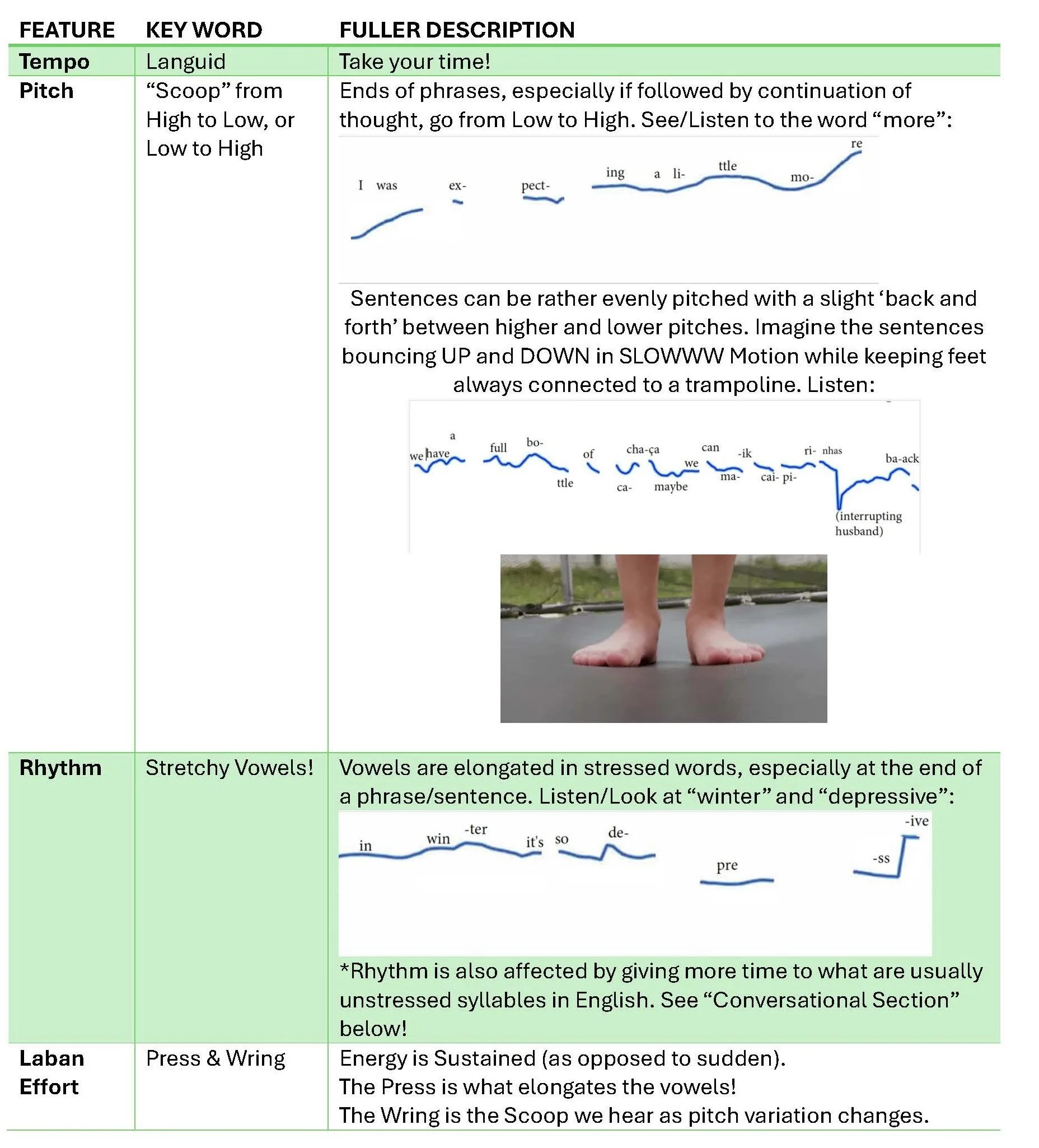
MAKING IT SOUND CONVERSATIONAL

RHYTHM with SCHWA fun!
A lot of syllables native English speakers ‘smush’ will get a lot more love. This will affect the rhythm!
Classic Examples:
“To” will always be a full “oo” sound.
Endings with “ed” are fully pronounced “ehd.”
Try it: “I told you TOO add some condense-ED miwk.”
Fun Fact: Condensed milk is used all the time in Brazil, particularly for desserts!
Listen: “fork tongue-ed horses…nobody like-ed the drinks…”
HOT TIP!
When a nasal consonant /n/ or /m/ precedes another consonant, we can drop the /n,m/ and replace it with the nasality we learned at the beginning!
Listen: “Our brother-in-law… is from there” = “he is fro’ dere.”
TRY IT:
“something” = “so-fing” “don’t go” = “do’ go”. “and he said” = a’ he said
OTHER SOURCES:
Filmmakers Felipe Matzembacher & Marcio Reolon (German influence): https://youtu.be/BBKG6DjveXs?si=1D5KKNMTcnXTukkf
Actress Bruna Fachetti (US influence): https://youtu.be/WWqqr8iQG1c?si=27czMOGa0PkApwvv